
How to Become a CA in Nepal: Eligibility, Fees, Salary, & Career Guide 2083
Chartered Accountancy (CA) is one of the most prestigious, globally recognized, and financially rewarding career paths in the fields of finance, taxation, and auditing. Unlike standard academic degrees, CA is a professional qualification that grants you a legal license to audit and certify financial records.
In Nepal, the corporate and banking sectors are expanding rapidly, making the demand for skilled financial experts higher than ever. If you have an analytical mind, a passion for numbers, and the determination to clear rigorous examinations, this Ultimate 2026 Nepal CA Guide will walk you through the entire journey step by step.
1. What is CA and Why Choose this Career?
Chartered Accountancy encompasses advanced accounting, auditing, commercial law, corporate finance, and strategic management. A CA acts as a trusted financial advisor to businesses, ranging from small startups to multi-billion-dollar conglomerates.
Core Benefits of Studying CA:
- 100% Job Security: As long as businesses exist and taxes are levied, the industry will always need Chartered Accountants.
- Global Mobility: The concepts of finance and accounting are universal, allowing CAs to transition smoothly into global roles.
- Diverse Career Profiles: You are not limited to bookkeeping. You can become a Chief Financial Officer (CFO), Internal Auditor, Tax Consultant, or Investment Analyst.
2. ICAN vs. ICAI vs. ACCA: Understanding the Differences
When pursuing a career in professional accountancy in Nepal, you will primarily choose between three streams. Knowing the difference is crucial before making your initial financial commitment.
| Feature / Course | ICAN (Nepal) | ICAI (India) | ACCA (UK / Global) |
| Governing Body | Institute of Chartered Accountants of Nepal | Institute of Chartered Accountants of India | Association of Chartered Certified Accountants |
| Legal Status in Nepal | Holds exclusive statutory rights to grant a Certificate of Practice (COP) for auditing. | Highly respected, but requires clearing transition exams via ICAN to practice in Nepal. | Great for corporate, MNCs, and INGOs, but cannot sign local statutory audits without ICAN membership. |
| Curriculum Focus | Nepalese Tax Laws, Mercantile Acts, and NFRS. | Indian Corporate Laws, Income Tax Act, and Ind-AS. | International Financial Reporting Standards (IFRS). |
3. CA Admission Eligibility: GPA & Percentage Requirements (2026 Criteria)
The academic prerequisites to register with ICAN vary depending on your educational stream.
⚠️ Important & Admission Update: ICAN updates its exact GPA thresholds periodically based on the National Examination Board (NEB) patterns. Always cross-check the official ICAN Admission Notice portal before processing your registration fees.
Eligibility Stream Matrix
| Prior Educational Background | Minimum Requirements to Enter CAP-I |
| +2 Management / Commerce | Clear NEB exams with the minimum aggregate GPA/percentage specified in the latest ICAN intake notice. |
| +2 Science | Open for entry. Science students often excel in CA due to strong quantitative skills. |
| +2 Humanities / Education | Eligible for entry, provided basic aggregate percentage criteria are satisfied. |
| A-Levels / International Diploma | Requires an Equivalency Certificate from the Curriculum Development Centre (CDC) or Tribhuvan University (TU) alongside ICAN’s verification. |
| Graduates (BBA / BBS / BBM) | Direct Entry Scheme: Commerce graduates with specified marks can skip CAP-I entirely and register directly for CAP-II. |
What if my +2 GPA is too low?
If your +2 marks do not meet the minimum criteria for immediate ICAN registration, your CA dream is not over. You can enroll in a Bachelor’s degree (like BBS or BBA), maintain solid academic performance, and enter the CA track directly at the CAP-II (Intermediate) level after graduation.
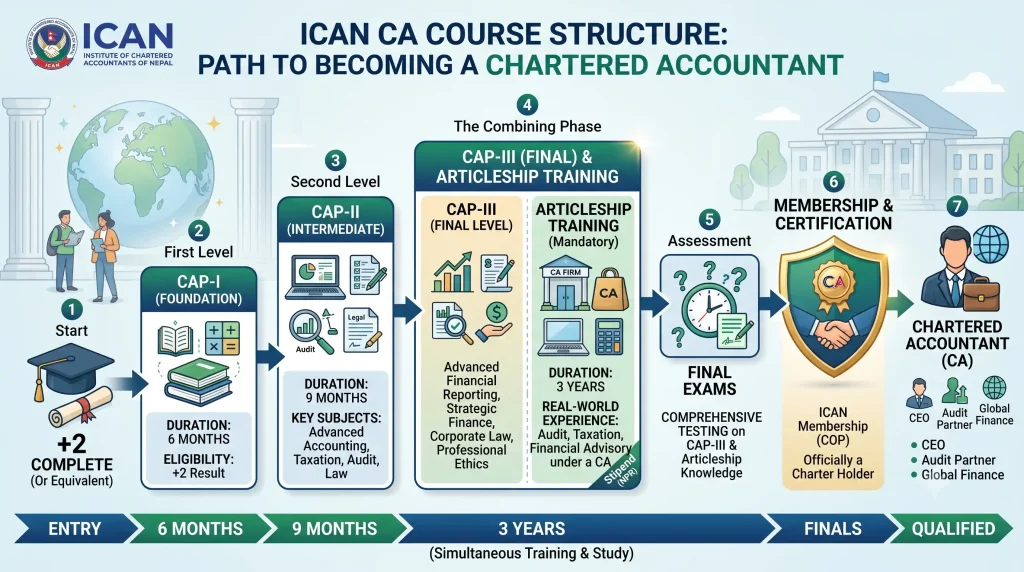
4. The CA Course Structure: CAP-I, CAP-II, & CAP-III Explained
The ICAN CA curriculum is structured into three distinct progressive tiers, interspersed with a mandatory internship phase.
[+2 Complete] ➔ [CAP-I: 6 Months] ➔ [CAP-II: 9 Months] ➔ [3 Years Articleship Training + CAP-III] ➔ [Final Exams] ➔ [Chartered Accountant]
Phase 1: CAP-I (Foundation Level)
- Duration: 6 Months.
- Objective: Introduces non-commerce students to the basics of business and reinforces core topics for commerce students.
- Key Subjects: Fundamentals of Accounting, Mercantile Law, Economics, Management, and Commercial Mathematics & Statistics.
Phase 2: CAP-II (Knowledge & Application Level)
- Duration: 9 Months.
- Objective: Dives deep into core professional fields. The subjects are split into two distinct groups.
- Key Subjects: Advanced Accounting, Auditing, Cost & Management Accounting, Taxation (Income Tax & VAT), Financial Management, Company Law, and Information Systems.
Phase 3: CAP-III (Final / Advisory Level) & Articleship
- Duration: 3 Years (Parallel processing).
- Objective: The culmination of the course. Students study advanced strategy while working daily under a practicing CA.
- Key Subjects: Advanced Financial Reporting, Strategic Management, Advanced Auditing, Corporate Laws, and Professional Ethics.
5. What is CA Articleship? (The Practical Blueprint)
Articleship is a mandatory, 3-year hands-on internship under a registered, practicing Chartered Accountant or approved CA Firm. This phase transforms students from theoretical learners into corporate audit professionals.
Real-World Competencies Developed During Articleship:
- Statutory Auditing: Verifying balance sheets, profit & loss statements, and asset registries of commercial banks, manufacturing plants, and public enterprises.
- Taxation Practice: Filing corporate income taxes, dealing with Inland Revenue Department (IRD) audits, and calculating Tax Deducted at Source (TDS).
- Financial Software: Master tools like Tally, Busy, SAP, and custom FinTech frameworks used by modern corporations.
💰 Stipend Insights: You are legally entitled to receive a monthly Stipend during your Articleship. ICAN regulates the baseline amount, which scales upward progressively during your first, second, and third years of service.
6. Detailed CA Fee Structure in Nepal (2026 Breakdown)
Compared to other premium professional paths like engineering or medicine, CA is highly affordable because it is administered by a non-profit statutory body (ICAN).
- ICAN Official Fees: This includes your lifecycle registration fees, examinations, and official textbook modules. For instance, the baseline CAP-I enrollment fee safely clusters around NPR 34,500 (with installment pathways available).
- Private Coaching Costs: While studying via a private CA college or specialized coaching center is entirely optional, most students choose it to tackle complex practical subjects.
- Total Estimated Investment: Over the course of 4.5 to 5 years, the total aggregate capital required (including ICAN registrations, exam forms, coaching classes, and supplementary study guides) sits roughly between NPR 3,500,000 to NPR 5,000,000.
7. ICAN Scholarships & Financial Support Networks
Money should not be a barrier to becoming a financial leader. ICAN rolls out highly structured scholarship programs every academic cycle:
- Merit-Based Scholarships: Automatically awarded to individuals topping entrance metrics or securing phenomenal GPAs in school-leaving exams.
- Need-Based Scholarships: Targeted at economically underprivileged students, marginalized demographics, or individuals hailing from geographically remote districts of Nepal.
- Coverage Matrix: Winners enjoy complete registration waivers, complimentary exam fee processing, and free textbook modules straight from the ICAN library.
8. Exam Patterns, Passing Criteria, and Daily Study Routines
The pass rate for CA globally is low, not because the content is impossible, but because the passing parameters require flawless consistency.
The Double-Condition Passing Rule:
To successfully clear a CAP exam stage, you must hit two separate targets simultaneously:
- Individual Subject Threshold: You must score at least 40% in every single paper.
- Aggregate Group Threshold: Your overall combined score across all subjects in that level or group must be at least 50%.
The Expert Recommended 8-Hour Study Routine:
- Core Conceptual Preparation: 5 hours of deep, distraction-free reading of standard modules.
- Active Revision Loop: 2 hours dedicated to reviewing notes from the previous week.
- Mock Testing: 1 hour working through past ICAN/ICAI question banks and tracking your time constraints.
9. Career Scope & Average Salary of a CA in Nepal
Upon clearing your CAP-III finals, submitting your logs, and obtaining your official ICAN membership card, you step into a premium hiring market.
Projected Market Salaries (2026 Index)
| Experience Tier | Average Monthly Salary Range | Primary Hirers / Industries |
| Freshly Minted CA | NPR 50,000 – NPR 150,000 | A & B Class Commercial Banks, Audit Firms, Hydropower Devs. |
| Mid-Level Executive (3-5 Years) | NPR 150,000 – NPR 300,000 | MNCs, Telecom Giants (Ncell/NTC), Top-tier INGOs. |
| CFO / Senior Partner | NPR 300,000+ (Plus Equity/Bonus) | Corporate Conglomerates, Insurance Groups. |
10. Frequently Asked Questions (FAQs)
Q1. Can a Science student smoothly transition to CA?
Yes. Science students possess strong logical and mathematical foundations. While accounting terms will feel completely new during the first two months of CAP-I, they catch up quickly once they grasp double-entry mechanics.
Q2. Can I study for a regular Bachelor’s Degree alongside CA?
Absolutely. Many students join private or government campuses to secure a BBS or BBA alongside their CA prep. This dual path gives you an academic degree as a backup option if your CA exams take a few extra attempts.
Q3. How many times can I attempt the CA exams if I fail?
There is no cap on attempts under ICAN rules. If you miss a group clear by a few marks, you can regroup, re-register for the next exam cycle six months later, and try again.
Q4. What happens if I clear CAP-II but get stuck on CAP-III?
Even if you face delays clearing your final papers, completing your CAP-II and 3-year Articleship makes you highly employable. You can work in corporate accounts departments as a Senior Accountant or Audit Manager while continuing to sit for your final exams.
Q5. Is an MBA necessary after completing my CA?
Not technically. A CA stands as a terminal professional qualification in financial sectors. However, if your long-term goal is to transition away from specialized finance into general corporate governance or international operations, an executive MBA later in life can provide a competitive edge.
Q6. Can a student with a +2 background excel in CA?
Yes, absolutely. Most Chartered Accountants start immediately after +2. Management students benefit from familiar accounting concepts, while Science and Humanities students excel by using their strong analytical and logical skills to master the syllabus.
Also Check
- Top 10 IT Colleges in Nepal: IT Courses, Fees, Scholarships
- Mega Info Tech Computer in Mahendranagar, Kanchanpur, Nepal