
Loksewa Ban Rakshak Syllabus PDF Download & Complete Prep Guide
The Public Service Commission (Loksewa Aayog), Nepal, has updated the official curriculum framework for the Ban Rakshak (Forest Guard) / Game Scout selection under the Nepal Forest Service. Aimed at the non-classified technical cadre within the General Forestry and National Parks & Wildlife sub-groups, this job requires candidates to prove exceptional physical stamina alongside sound conceptual field knowledge.
Whether you are applying for federal vacancies or provincial openings (such as Koshi, Madhesh, Bagmati, Gandaki, Lumbini, Karnali, or Sudurpaschim), this master guide covers everything. Read below to understand the scoring metrics, physical test benchmarks, step-by-step written subjects, and expert preparation strategies, and access your verified PDF download link.
Complete Selection Scheme & Marks Distribution
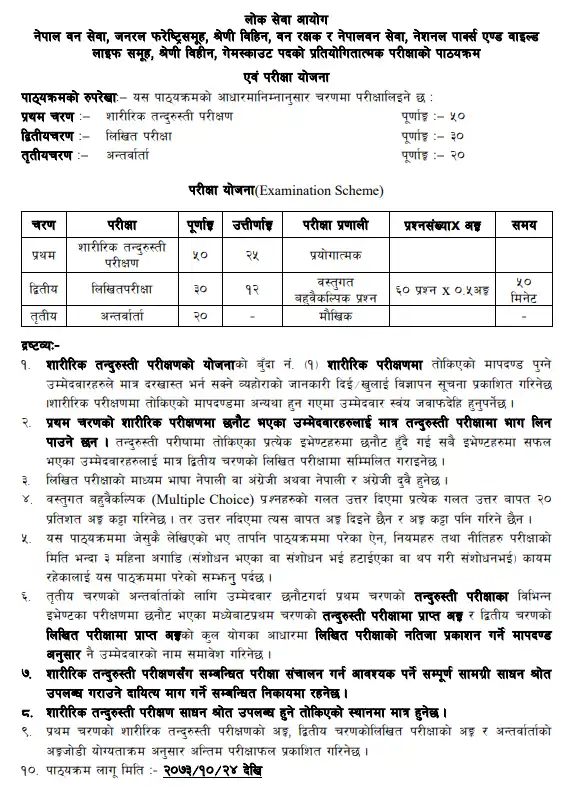
Securing a permanent position as a Forest Guard involves clearing three independent phases. Only candidates who successfully qualify through the physical tests are permitted to take the objective written exam.
| Phase | Evaluation Area | Exam Type | Marks Assigned | Time Allotted |
| Phase 1 | Physical Screening & Fitness | Medical Check & Practical Stunts | Qualifying Only | Variable |
| Phase 2 | Job-Specific Technical Ability | Multiple Choice Questions (MCQs) | 100 Marks | 50 Minutes |
| Phase 3 | Behavioral Suitability | Oral Interview Panel | 20 Marks | 15–20 Minutes |
Phase 1: Physical Fitness Standards & Testing for Ban Rakshak
The first phase acts as an absolute filtering mechanism. Candidates must meet standard medical benchmarks before attempting the physical stamina events:
1. Medical Baseline Requirements
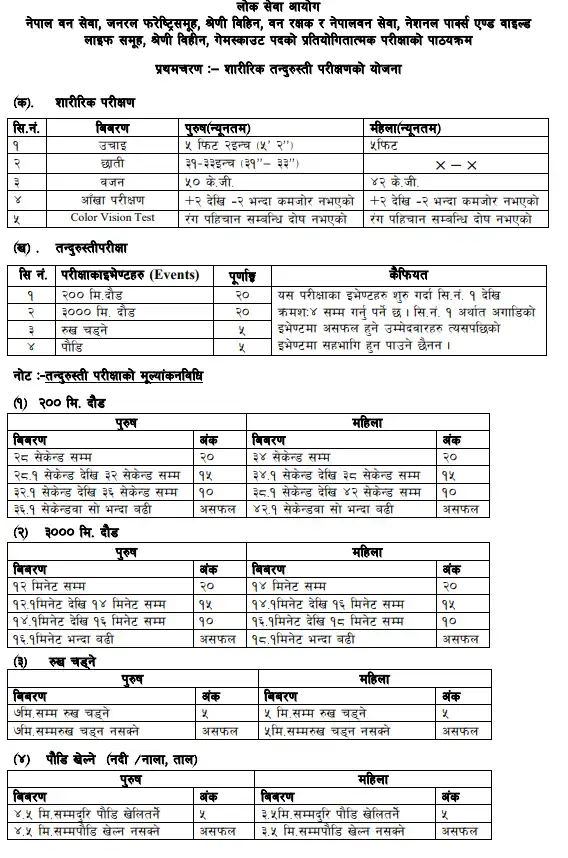
- Height Matrix: Minimum 5 feet 2 inches required for Male candidates | Minimum 5 feet required for Female candidates.
- Chest Expansions (Males Only): Must measure at least 31 inches normally, expanding to a minimum of 33 inches.
- Weight Baseline: Minimum 50 kg for Males | Minimum 42 kg for Females.
- Visual Acuity: Vision must be structurally healthy. Refraction anomalies worse than +2 or -2 drop qualifications instantly. Passing a standard color blindness test is mandatory.
2. Practical Stamina Performance Events
- 100-Meter Dash: Evaluates acceleration and fast reflexes.
- 3,000-Meter Distance Run: Measures cardiovascular health, lung power, and pacing stamina.
- Tree Climbing Drill: Testing practical agility to safely scale and descend a typical field tree structure.
- Swimming Challenge: Demonstrating smooth water traversal skills across a set distance.
Phase 2: Written Examination Detailed Topics
The written paper features 50 Multiple Choice Questions (MCQs) valued at 2 marks each. There is negative marking for wrong answers, meaning accuracy is just as important as speed.
Section A: General Forestry Concepts
- Forest Typology: Geographical distributions of sub-tropical, temperate, and alpine forests across Nepal. Characteristics of high-value trees like Sal, Sisau, Khayer, Simal, and Deodar.
- Forest Mensuration: Fundamental field mathematical conversions for measuring tree height, log diameters, and wood volume calculations.
- Silviculture & Nurseries: Practical nursery bed setups, soil mixing ratios, seed gathering seasons, transplantation gaps, weeding schedules, and sapling protection.
- Wildfire Management: Causes of forest fires, manual construction of clean fire lines, operational maintenance of traditional fire tools, and preventive drills before dry seasons.
- Forest Security Management: Preventative field patrolling techniques to stop illegal logging, structural boundary encroachments, timber smuggling, and uncontrolled cattle grazing.
Section B: Wildlife Management & Protected Areas
- Protected Area Framework: History, ecological zones, and locations of National Parks, Wildlife Reserves, Hunting Reserves, Conservation Areas, and surrounding Buffer Zones in Nepal.
- Fauna Identification: Behavioral traits and statutory listings of endangered, strictly protected mammals, reptiles, and bird species of Nepal.
- Human-Wildlife Interface: Identifying root triggers of dangerous wildlife interactions near village borders, electric fencing installation methods, crop raiding handling, and public compensation distribution protocols.
- Anti-Poaching Operations: Identifying complex animal traps, footprint tracking (pugmarks), night patrolling strategies, and secure field communications inside dense environments.
Section C: Community Forestry & Natural Infrastructure
- Participatory Forestry: Legal differences between Community Forests(Ban Rakshak), Collaborative Management, Leasehold Allocations, and Religious Protected Woods.
- Non-Timber Value Products (NTFPs): Sustainable identification, commercial harvesting seasons, curing, and warehousing of alpine medicinal plants like Yarsagumba, Panchaoule, Jatamansi, and Harro/Barro.
- Watershed Preservation: Methods of controlling soil erosion, planting root-binding flora like bamboo on vulnerable slopes, and structural management of natural mountain water sources.
Section D: Legislative Frameworks & Institutional Code
- Statutory Forestry Law: Essential legal sections of the Forest Act and active forest administrative rules.
- Conservation Jurisprudence: Fundamental understanding of the National Parks and Wildlife Conservation Act.
- Law Enforcement Protocol: Legal steps required for detaining suspected poachers, drafting legal seizure receipts for smuggled timber trucks, and filling basic preliminary case descriptions.
- Code of Professionalism: Structural command hierarchies within the Forest Service, proper preservation of the official uniform, regular drill disciplines, and field codes of conduct.
Exclusive Study Guide & Ban Rakshak Preparation Tips
To outperform other candidates, you need a smart Ban Rakshak Preparation strategy. Use these proven tips to give yourself an edge:
- Build Physical Stamina Early: Do not wait for the physical results to start training. Practice long-distance running twice a week and work on your swimming and tree-climbing techniques early on.
- Master the Forestry Acts: Questions on the Forest Act and National Parks Act are highly precise. Memorize key sections, amendment dates, and penalty clauses exactly as they are written.
- Solve Mock MCQs Weekly: Set a timer for 50 minutes and practice solving full 50-question sets. This helps build the speed needed to handle the real exam’s strict time limit.
- Study Local Flora and Geography: Pay close attention to the specific forest types and protected wildlife native to the province where you are taking the exam.
- Keep Up with Current Affairs: Review the latest economic surveys and forestry statistics published by the Ministry of Forests and Environment to catch any recent policy updates.
Also Check
- Nepal Rastra Bank NRB Syllabus for Assistant Director
- Rastriya Anusandhan Bibhag Syllabus
- Nepal Rastra Bank Syllabus
- Sudurpaschim Pradesh Kharidar Syllabus